part three: the walk

This is part three in a three part series. Read part one here and part two here.

So if our marriage had been drowning in the first part and rescued in the second part, part three should surely be our “happily ever after” right?

Riiiiight.

When I was 16, I would think through the years of my life and how I thought it would all play out:  I would graduate high school, go to college, graduate college, get a job, get married, have kids… and then my life would be over and void of any personal satisfaction or meaning.  What a stark vision of the future! In this entire vision of the future, the wedding was the pinnacle of it all. It would be the happiest day of my life and all the days before would be the crescendo and all the days after would be the sad denouement.

I figured the best years of my life would probably be the years between college graduation and marriage – full of wonder and potential and hope and excitement – and the cherry on top would be a wedding.

Funny story: there were only 18 months between college graduation and our wedding.

There is so much emphasis on having The Perfect Wedding. The perfect dress, an idyllic ceremony that is both representative of your separate histories as well as of your hopes for the future, a party-inducing play list, the right lighting, and so on and so on.  And I am the first to admit, I do love a great wedding!

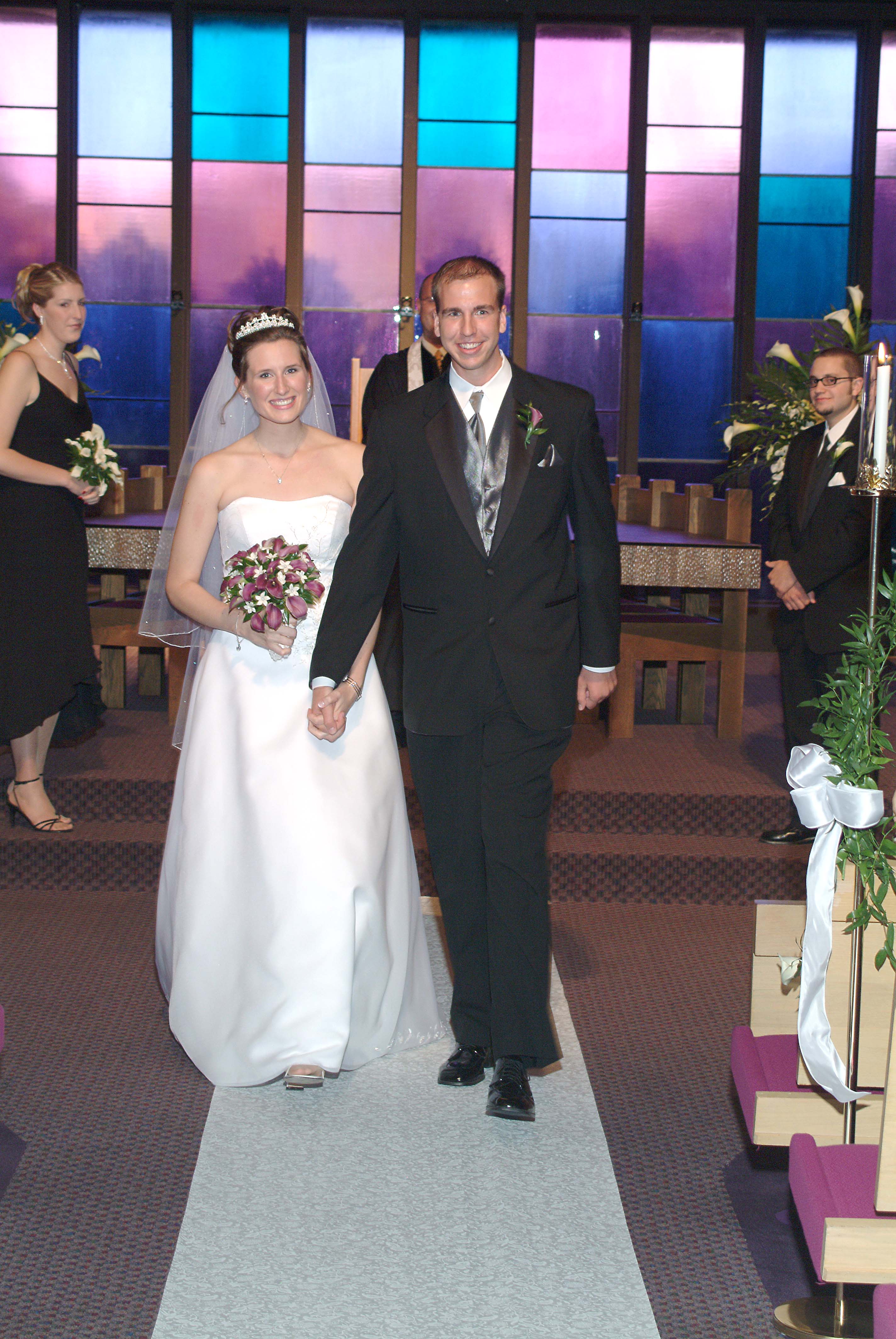
I love watching the groom see his bride for the first time. I love watching the bride’s family give her away to a teary-eyed, clammy-palmed groom.  I love a great ceremony. I love the first kiss.  I love the celebratory walk up the aisle.

“The journey of a thousand miles begins with one step.”

The first steps back up the aisle truly begin a journey of a thousand miles. The walk back up the aisle, full of hope and promise and purpose and joy, signifies how we intend to began our marriage. It can be so easy to lose that momentum, though.

Marriages aren’t perfect, but marriages are beautiful and complex and unique and messy. It’s just that most of us don’t really know how anyone else’s marriage truly works except maybe our parents’ marriages. We see weddings and we see 50th wedding anniversaries.  Sometimes our friends let us see under the tent – a peek at an argument or an accidental glance of tender moment. But it’s hard to get context. We don’t often truly understand the inner-workings of most peoples’ marriages.

Writing this series presented that very problem. I am giving you a very specific peek into our life – into a part of our life that was particularly messy and difficult. This period of time certainly shaped our life moving forward, but it is only a picture of a moment in time.

I sometimes find myself wondering: what are other peoples’ marriages like? What do they talk about? What do they like? Do they talk at dinner or eat in silence? Do they go to bed at the same time or is one person a night owl while the other is a morning person?

Is it normal to want to talk to your spouse all. the. time? Is it normal to always want to hold hands or touch each other as much as possible? Is it normal to be grateful your spouse travels?

Are we normal? Are we OK?

I’ve come to the conclusion, after much thoughtful consideration: WHO CARES what is normal!?

Instead of normal, I’ve found myself craving people and experiences that are authentic and genuine and real. The uncomfortable thing I’ve discovered is that very few things live inside a comfortable little box of good/bad, wrong/right, beautiful/ugly.

In this new space of intimacy and knowing and closeness, we’ve come to realize there is so much in life that is beautiful and messy, delightful and terrifying, or happy and sad – all at the same time.  Even when I really reflect on the way that I felt on our wedding day, it was a broad and brilliant array of emotions that included everything from sadness that many of our grandparents couldn’t share in our day to elated to celebrate our wedding with so many family and friends. Life, as far as I can tell, is full of moments that defy limited categorization.

That being said, I would love to gloss over our post-drowning marriage and say, “Yep, all good here! There’s nothing to see here! Move along!”

But.

A few weeks ago we had a pretty big fight that started before church (AWESOME) and concluded after lunch (C’MON!). Frank had a bunch of feelings and I had a bunch of feelings, but we were afraid to talk about these feelings because neither of us wanted to burden the other with these feelings. So we actually fought about how he answered a question that I asked. The exchange in question was no more than a dozen words between us, but all of the feelings came bubbling up. For quite a few hours we snipped and argued back and forth. It took us hours to realize that we needed to go back to the now familiar territory of compassionate and honest communication. Once we started talking, we realized that neither of us was burdened and that both of us actually had very similar feelings on the issue at hand.

It wasn’t the similarity in our feelings, but the authenticity of our feelings, that gave me the biggest sense of relief. I knew Frank’s heart and he knew mine.  We couldn’t really do anything about the feelings or even the issue we were upset about, but we could encourage and walk alongside each other.

So here is what I have to say about our life together: it is messy and imperfect and complicated, but it is ours.

Frank and I try to set aside time weekly to talk in person without distraction. Sometimes we talk about what we are thinking and feeling, sometimes we talk about what is going on in our lives, sometimes we talk about dreams and ideas and sometimes we talk about practical matters. Sometimes we talk about our strategy for dealing with a zombie outbreak. Our conversations are not confined by anything – sometimes not even reality!

And so, we keep finding our way back to one another. I met another couple who found their way back through a shared hobby. Some couples exercise together and some couples travel.  The important thing is that they create space for connection.

I feel like people often mistake the act that creates space for intimacy as actual intimacy.

I know that I used to get confused on this issue a lot. I used to think of sex as intimacy, when it is an opportunity for intimacy. I used to think that going on a date is intimacy, when it is a space where connection can happen.

Intimacy is closeness and knowing and understanding.

I think that sometimes I get lazy and I want to check the box and have intimacy without having to be vulnerable, without having to put myself out there. Sometimes I get scared to hear what Frank really thinks and feels – worried that I will be responsible and blamed for his feelings.

But.

It is worth it to be brave in order to be known, to be seen, to be heard. It is worth it to be brave enough to know, to see, and to hear another.

We’ve had a challenging year. We’ve dealt with quite a few different illnesses and transitions and minor floods – just a lot of stuff.

And yet…

We are on this journey of a thousand miles that began with both of us holding hands and smiling big, toothy grins. If all goes well, after walking through jobs and houses and kids and life together, we will still be walking, holding hands and celebrating the joy of our adventure.

My 16 year old self would be relieved.

part two: the rescue

This is part two of a three part series about the rescue of a drowning marriage. To read part one, click here.

***

“We need help.”

These three simple words were immediately followed by lots and lots of other words.

It was messy, frustrating, beautiful, sweet and sad all at once.

Our first therapist appointment was an orientation. What was the world of our marriage as we understood it? What did we think the problem might be?

The Problem

Defining the REAL problem can be difficult when all of the symptoms of the problem also look like problems.

I thought the problem with our marriage was that Frank was not partnering with me on my agenda.

Frank was equally certain that the problem with our marriage was my inability to get on-board with his agenda.

Clearly, one of us was absolutely wrong and it wasn’t me.

In our second meeting, our therapist asked Frank to describe his family of origin (a fancy way to describe the family you were raised in).

And so Frank began to speak…

While I was listening to Frank talk about his family of origin and the people he loved and his stories and his life, I realized I was genuinely listening to Frank for the first time in months. I realized that I was soaking him in. It reminded me of something familiar and lovely and warm: it reminded me of one of our first dates.

One of our very first dates was to a restaurant called John’s Place in Lincoln Park (now the White Oak Tavern & Inn). Our conversation was light and quick and funny. My face hurt from smiling so much. I wanted to know everything about Frank after that date. He was one of the most fascinating and spellbinding humans I had ever met.

We spent our first nine months of dating learning everything we could about each other while simultaneously trying to create new memories together. It was dizzying and exciting and intense. And then Frank proposed and we spent six months planning our wedding together and taking premarital classes with quizzes and personality tests. Every avenue we walked down was an opportunity to learn more about the other person.

At some point – maybe it was while having twins or maybe it was while Frank lived in Atlanta most of the month or maybe it was while we were sprinting through life, we stopped really knowing each other. We stopped running together.

So it goes – one thing leads to another and to another and then we were in therapy and Frank started talking about his life. I knew many of the stories, but had forgotten some and needed reminding about facets of others. I found myself watching him talk and feeling my heart thaw.

All of the pretense and pain and mess of life melted away. The more I learned about Frank, the more I wanted to know. Good, bad, ugly. Whatever.

Intimate partnerships thrive on knowing and being known. When couples who know each other intimately are separated by time and space, they long for the other. They thirst for their other half.

It sounds silly and cliche, but I think this was the heart of our problem: we were thirsty for each other.

Thirst is a tricky thing. Thirsty people often think they are hungry. That’s why most diets and eating programs insist that participants drink plenty of water. Most of us have been walking around our entire lives thinking we were hungry, when more often than not, we were actually quite thirsty.

That’s how it was for us in our marriage: we were thirsty. We thought we wanted our spouse to act differently or to follow our agenda – but really, we were thirsty to know and be known.

The other thing about thirst is that once you realize that you are thirsty, you are already dehydrated. Once we realized there was a problem with our marriage, we were already pretty far down a troubling road.

Realizing that the problem was that we were missing genuine intimacy was only the beginning. We needed to figure out our way back to a place where we could know each other.

So here is what our counselor did: he gave us a road map for communicating more effectively. He recommended a book called Nonviolent Communication (don’t get hung up on the title – it’s not about actual physical violence) which gave us the framework for expressing ourselves in a healthy way. Aside: The book is awesome and provides so many examples and concepts that are useful in all types of relationship/interpersonal situations. If you want to learn more, I highly recommend it.

In a nutshell, the concept is that you state what you observe (he was late), how you felt (and I was frustrated), what you need/value (I could have used that time to do other things) and a request (do you think you could let me know when you are going to be late in the future).

The result is that we own our emotions and our emotional response to things. Frank doesn’t make me feel a certain way. He does things and I have an emotional response. He can’t change my feelings, but he might be able to change his behavior.

And vice versa.

We also became aware that expressing emotions is very difficult in the English language. A great example is that other languages, like Greek, have multiple words for the concept of love. There is the love you have for your spouse, the love you have for ice cream and the love that you have for your friends. In English, we just use the word “love” and hope the listener understands the subtle yet significant differences in intention. Other languages use entirely different words to describe different types of love. We spent some time reviewing words that describe emotions so that we would have a greater breadth of language to use with each other.

Once we had a framework for communicating and words to use, we just started talking. It was, at first, like drinking from a fire hydrant; the conversations came so quickly and with such intensity that we almost couldn’t keep up with it. We talked about our marriage, our lives, what we loved, what we feared, who we want to be when we “grow up,” our daily struggles, and so on and so on and so on.

But those conversations, over the course of weeks, helped us find our way back to each other.

Some of these were hard conversations. It is hard to hear from your spouse that what you did or what you failed to do caused them pain. It was hard to take responsibility for the part I had in the blaming and posturing and distancing.

This kind of examination and vulnerability required a LOT of trust between us. We had to trust that we could be honest without fear that our comments would be used against us in our (inevitable) next argument. We had to trust that our spouse wouldn’t feel responsible, and therefore hurt and resentful, when we had differing opinions and feelings about topics. We had to trust that our conversations would be met with compassion, kindness and love.

Truly, that kind of trust is only possible when two people are more interested in the good of the other. We had to be certain that the other person would receive our feelings and stories and ideas without judgement. The only way to be sure, though, was to be vulnerable and to see what happened. Try, succeed, fail, forgive – on repeat.

As we moved towards the other, we sent out “feelers” to make sure it was safe to share. It felt sometimes like two people in opposite trenches, peering out across a battlefield. Will he shoot? Will she lob a grenade?

Over the course of consistently kind and honest conversations it became clear to us that we would listen and love and be compassionate, which meant even more feelings and experiences and stories came tumbling out.

The result of using the tools we learned in therapy and building trust between us was that we both felt known and heard and loved. For the first time in years, we felt truly connected. We were on our way home – we just had a few more hurdles to clear…

Part three: the walk